Securelytix turns 2 years old! Here are the things we’ve learned as a startup and some lessons for early-stage entrepreneurs & companies. Startup lessons from Securelytix.
It’s a moment of total happiness and pride today. Not just me, but for our entire team at Securelytix. Looking back, there is a lot to cherish, think over the lessons that we’ve learned, and some of the achievements that we’ve garnered.
How it all Began
Securelytix wasn’t born in a comfortable environment.
We started our journey in one of the most commoditised markets in India – payments.
But even in that crowded space, we found a unique gap.
Most large players like Cashfree and Razorpay were focused on high-volume enterprise merchants, while millions of retail merchants across India lacked proper support, onboarding assistance, or distribution touchpoints.
We solved that problem by building a strong, on-ground + digital distribution engine that could onboard and support merchants that others ignored.
The result?
- Strong unit economics
- Healthy cash flows
- And profitability in our very first year
The payments business became auto-pilot — operations were smooth, predictable, and scalable.
But I always wanted to solve harder engineering problems.
And somewhere inside, I knew payments wasn’t the final destination.
Coming from a core digital banking background, I had seen the dark side of data first-hand:
frauds, KYC leaks, unauthorised profiling, misuse of customer information — happening across the ecosystem.
So I went deeper.
I spent 2–3 months researching the privacy and cybersecurity landscape, understanding global architectures, threat vectors, upcoming regulations, and gaps in India’s infrastructure.
During this time, I decoded platforms like Skyflow, our closest global benchmark, and realised something important:
India lacked a modern, enterprise-grade data privacy infrastructure that could support the scale of digital adoption and the explosion of AI workflows.
That clarity changed everything.
The transition started — fast.
We made a bold move:
pivoting from payments into building a next-generation data security SaaS platform for India and emerging markets.
This wasn’t just a business shift — it was reinvention.
We doubled down on:
- Privacy engineering
- Tokenization
- Secure compute
- Data governance
- Enterprise-grade vaults
- AI-safe pipelines
And all this happened while an entire nation waited for the DPDP Rules — the regulation that would finally formalise privacy architecture in India and unlock a massive market opportunity.
What we’ve Learnt in this Past One Year
I’d love to take this opportunity to share with all of you the things we’ve learned as a startup and some of the lessons that early-stage entrepreneurs & companies can pick up on.
Building a Team
Setting the culture right from the start was something I have always been particular about. Like the lego blocks laid neat to erect a fantastic architecture.
It goes without saying the immense appreciation and the gratitude we have for the initial employees who joined us. It takes courage and determination to trust just an idea alone and hold hands to turn it into a reality.
In the early days of Securelytix, we went through more attrition than we ever expected.
And looking back, most of it was because we hired wrong.
Like many early-stage founders, we sometimes hired in desperation — because we needed velocity, we needed resumes filled with big-brand pedigree, and we believed pedigree equaled performance.
Despite warnings from key stakeholders, we brought in people who were largely driven by short-term money, not long-term mission.
They didn’t believe in the vision deeply enough.
They didn’t have the conviction to grind through uncertainty.
And some were simply misaligned with the culture we were trying to build.
The truth hit us early:
In 0→1, you don’t just need skill.
You need attitude.
You need hunger.
You need people who believe in the vision even when the world doesn’t.
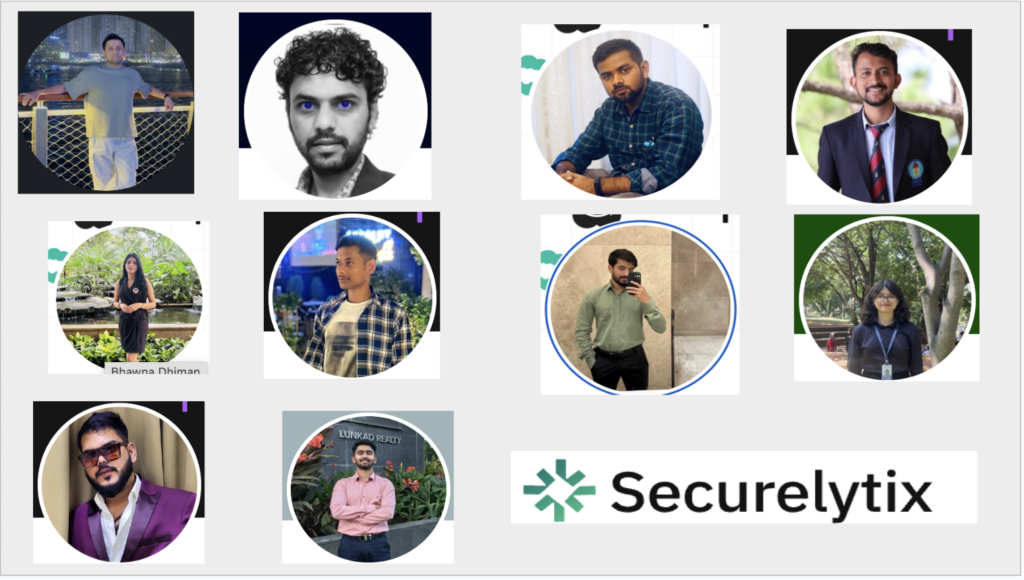
Here are our rock stars who put their best foot forward in anything they do
The Tech Team: Sprints, Engineering Discipline & Solving Real Problems
As a product-led company, building a strong and mission-aligned tech team wasn’t optional — it was foundational.
In the 0→1 phase, your engineering team becomes the heartbeat of the company, and we knew ours had to operate like a well-oiled, high-ownership machine.
Securelytix has been growing fast, and naturally, the tech team has become one of our fastest-expanding units.
But growth alone isn’t the goal — clarity, discipline, and first-principles thinking are.
Our Engineering Philosophy Is Simple:
1️⃣ Approach every problem from First Principles.
Strip away assumptions. Understand the core pain point.
Then rebuild the solution ground-up with clarity.
2️⃣ Solve for fundamentals rather than shortcuts.
In cybersecurity and privacy, quick fixes create bigger cracks later.
We took the harder route: correctness > speed, architecture > hacks.
3️⃣ Let data guide decisions.
When we began, our infrastructure was intentionally simple — a plain-vanilla architecture that allowed us to observe real behaviour.
We monitored API usage, traffic patterns, latency, and load characteristics extremely closely.
These insights shaped every scaling decision, including:
- when to break into microservices
- when to introduce containerization
- when to adopt async workers
- when to decouple storage and compute
- when to introduce more advanced privacy layers
This approach served us exceptionally well.
Instead of scaling prematurely — or architecting for imaginary problems — we scaled exactly when the product and customers demanded it.
4️⃣ Sprints with clarity, not chaos.
Every sprint had a single question at its centre:
“Does this move the product towards a more secure, more compliant, more scalable state?”
If the answer was no, it didn’t make the sprint.
5️⃣ Rapid resolution is part of our culture.
Build → deploy → observe → improve.
Whether a bug, an optimisation, or a design gap — the team is trained to respond quickly and learn even faster.
Individual Productivity: Creating an Environment Where People Do Their Best Work
Productivity isn’t just about hours or deadlines — it’s heavily shaped by the nature of work itself.
At Securelytix, we’ve learned that people deliver their best when their responsibilities align with their natural strengths, interests, and long-term aspirations.
So from the moment someone joins us, we try to understand what truly excites them — whether it’s deep backend engineering, security research, UI/UX, data structures, or customer-facing problem-solving.
Whenever possible, we align tasks with these interests.
The outcome is predictable:
higher ownership, stronger focus, and genuine passion for the work.
At the same time, we believe growth happens at the edges of discomfort.
So we actively encourage team members to experiment, pick up new skills, explore unfamiliar problem areas, and push past the boundaries of their comfort zone.
When It Doesn’t Fit: Knowing When to Part Ways
Letting people go is one of the hardest parts of building a company – especially in the early stages.
In the beginning, every hire carries enormous weight. They influence culture, set the pace, shape the foundation, and directly impact how fast you build and ship.
When the team is small and tightly connected, the importance of making the right hiring choices becomes even more magnified.
But startups are unpredictable by nature.
Sometimes, despite the best intentions, there ends up being a mismatch – not always immediately, sometimes months down the line.
It may show up as a performance gap, lack of ownership, friction with culture, or simply misalignment with the mission.
So what do you do?
First, you give room to improve.
You provide clarity, context, coaching, and enough time for the person to realign with the expectations and the company’s north star.
But if the gap continues despite repeated support, the kindest decision – for both sides – is to separate amicably.
A misfit delays the company and restricts the individual’s own growth in a role they may not truly be meant for.
Parting ways isn’t failure.
It’s a necessary step to protect the momentum of the team and open new opportunities for the individual.
This has been a part of our journey from day one.
And while there is still a long road ahead, one thing remains unchanged: we are committed to building a team that deeply believes in our mission of shaping the next generation of data security for the AI-first world.
Cracking the First Customer: The Hardest Battle in a Young Market
For a data-privacy and security startup in India — where companies still see security as a cost rather than a competitive advantage — it’s even harder.
Unlike payments or fintech APIs, the data-security market in India is still very young.
Most organisations historically treated security as “IT’s responsibility” or a compliance checkbox.
And we were entering a space that required education, evangelism, and mindset-shift, not just product demos.
But we were early movers, and we knew the wave was coming.
DPDP was around the corner.
AI workloads were exploding.
Enterprises were handling more PII than ever before.
So we hustled.
A lot.
We pitched to 50+ enterprise customers, including BFSI, fintech, SaaS platforms, lending companies, and digital-first brands.
Many conversations went nowhere.
Many asked, “Why do we need this now?”
Some asked for 100% customized solutions.
A few didn’t understand DPDP at all.
But giving up was never an option.
How We Approached the Problem & Broke It Down — Team by Team
At Securelytix, one of our core beliefs is simple:
a startup grows when its people grow.
From day one, we focused on helping individuals discover their real strengths and enabling them to use those strengths to solve meaningful problems.
Instead of forcing roles, we built an environment where each team member could take ownership, operate with clarity, and contribute to the mission in their own highest capacity.
To execute fast in a complex domain like data security, we broke the problem down teamwise — engineering, product, compliance, customer success, GTM — ensuring every team understood exactly why we were building something, not just what we were building.This alignment helped us move quickly, stay focused, and deliver a product that matched the ambition of the market we wanted to transform.
The HR Realisation: The Function I Once Underestimated
Coming from an engineering background, I’ll admit — I used to underestimate the importance of HR.
In the AI era, I thought HR was becoming optional or “nice to have,” and that product and engineering alone could drive the company forward.
I was wrong.
Completely wrong.
As we grew, I learned firsthand that without a strong HR function, it is nearly impossible to retain culture, scale people, or build the behavioural foundation a startup needs to survive 0→1 and beyond.
HR became the backbone that:
- protected and nurtured our culture
- ensured the right practices were followed
- handled an enormous amount of unproductive but necessary operational load
- enabled the core team to focus purely on building, selling, and scaling
- brought structure where chaos naturally exists in early-stage companies
While we were pushing product and engineering at full speed, HR quietly ensured that the company didn’t fall apart on the people side.
Today, I know this for a fact:
Great HR doesn’t slow you down — it frees you up to move faster.